Friday, April 17, 2026

The Bridge to Better Literacy: Connecting Research, Practice, and Systems

What My Doctoral Study Revealed About the Role of Reading and Writing Specialists in New Hampshire Elementary Schools


The Heart of the Work

Implementing Science of Reading–based instruction through LETRS training and the adoption of high-quality instructional materials has been an important step forward for New Hampshire schools. However, while the field has made significant investments in training and access to strong content, my doctoral research found that translating this knowledge into practice is more complex than training alone can address—requiring intentional leadership, coherent systems, and the strategic use of Specialized Literacy Professionals (SLPs), referred to as Reading and Writing Specialists in New Hampshire, who are uniquely positioned to lead this next phase of the work.

My study sought to answer the questions:

  • What are the perceived roles and responsibilities of Reading and Writing Specialists in NH elementary schools?

  • What barriers and supports do Reading and Writing Specialists in NH elementary schools experience, and how do these factors influence their ability to fulfill their professional roles?

  • How do Reading and Writing Specialists in NH elementary schools describe their knowledge of and involvement in implementing SoR-aligned practices and the impact this knowledge has on students?


Through open-ended questionnaires and semi-structured interviews, I collected data from 50 Reading and Writing Specialists that represents 8 New Hampshire counties and 25 districts. What emerged from the study was a powerful shift in how we understand the role of Reading and Writing Specialists. They are no longer just interventionists, but are also instructional experts and system-level leaders, working at the intersection of research, policy, and classroom practice. With deep knowledge of the Science of Reading, often strengthened through LETRS training, Reading and Writing Specialists are uniquely positioned to support teacher learning, strengthen Tier 1 instruction, and ultimately improve student outcomes.

But here’s the reality: their impact doesn’t depend on knowledge alone. It depends on the system around them. When there is strong administrative alignment, clear roles, and coherent systems, Reading and Writing Specialists can lead meaningful change. When those conditions are missing, their influence is limited. This shift from intervention-focused roles to broader literacy leadership underscores a critical truth: improving literacy outcomes isn’t just about what we know, it’s about how our systems are designed to support that knowledge in action.


What emerged from my findings was a conceptual framework I call the Bridge Model of SLP Leadership. The Bridge Model of Literacy Leadership positions Reading and Writing Specialists as connectors across three essential domains: relational, knowledge, and structural leadership. Together, these domains enable leaders to translate the Science of Reading into effective classroom practice by building trust, developing educator expertise, and aligning systems, including curriculum, assessment, and professional learning. When all three are in place, schools can create strong, equitable, and sustainable literacy systems that consistently support high-quality Tier 1 instruction.


Key Takeaways:

From Interventionists to System Leaders

One of the most significant findings from this study is the evolving role of Reading and Writing Specialists. While direct support for students remains an important part of the work, SLPs increasingly view their greatest impact as extending beyond intervention to instructional leadership, data-informed decision-making, and professional learning. The focus has shifted toward prevention, strengthening Tier 1 instruction as the most powerful lever for improving student outcomes. This marks a fundamental transition for Reading and Writing Specialists from supporting individual students to influencing entire systems.

At the same time, this shift is not without tension. Many participants described the ongoing pull between working directly with small groups of students and engaging in coaching and systems-level work. Yet, there was a strong recognition that investing in teachers through coaching has a broader and more sustainable impact by reaching not just a handful of students, but entire classrooms.

Bridging the Science of Reading to Classroom Practice

Reading and Writing Specialists are uniquely positioned to translate the Science of Reading into meaningful classroom practice. Many described their knowledge, often deepened through LETRS training, as foundational to their work. But what sets them apart is not just what they know, but what they do with that knowledge. Through coaching, modeling, and collaborative planning, they help teachers move from understanding research to effectively implementing it. Their impact is often multiplied through this work with teachers, an investment in adult learning that ultimately reaches far more students.

The Central Role of Tier 1 and System Coherence

A consistent theme across the research was the central importance of Tier 1 instruction. Reading and Writing Specialists emphasized that when core instruction is strong and consistent, the need for intervention decreases and outcomes become more equitable. This systems-level perspective positions them as key drivers of coherence, working to align curriculum, instruction, and assessment. At the same time, they are often navigating competing demands, from balancing direct student support to the broader work of improving instruction across classrooms.

The Conditions That Shape Impact

What became clear is that the effectiveness of Reading and Writing Specialists is not determined by knowledge alone. It is shaped by the systems in which they work. When there is strong administrative alignment, a clear district vision, and structures that support collaboration, they are able to lead meaningful instructional change. When those conditions are missing, their impact is limited. Participants described challenges such as unclear role expectations, limited time for collaboration, and inconsistencies in curriculum and data use. Many also noted a sense of professional isolation, particularly when they were the sole literacy leader in a district. Despite these challenges, SLPs consistently demonstrated adaptability through leveraging relationships, advocating for change, and maintaining a strong focus on student outcomes.

A New Way to Think About Literacy Leadership

These findings led to the development of a conceptual framework—the Bridge Model of Literacy Leadership. This model positions SLPs as leaders who operate across three interconnected domains: relational leadership, knowledge leadership, and structural leadership. In this role, they act as connectors through bridging research to practice, supporting teacher learning, and influencing the systems that shape instruction.

The takeaway is clear: improving literacy outcomes isn’t just about building knowledge. It’s about building systems…and the leaders who can connect them.


Sunday, August 27, 2023

Updates to New Hampshire's Dyslexia Screening Law - HB 377


As you may know, the last legislative session in NH saw the passage of HB 377. This bill is an update to the prior Dyslexia Screening law passed in 2016. HB 377 includes updates to the original bill, including:
  • Widening the requirement for screening to all K-3 students in public and charter schools
  • The screener must be given within the first 60 days of school and completed on additional time during the school year
  • If a student is flagged as "at risk" by the evidence-based universal screener, then additional secondary assessments must be completed to determine the next steps, which could include:
    • evidence-based literacy intervention 
    • a referral to for special education testing
  • Parents must be notified when their child is flagged as "at risk" by the universal screener and provided with assessment data and progress monitoring once a plan is developed with their input.
  • Parents of students identified as "at risk" have the right to submit independent evaluations completed by a licensed reading specialist trained in dyslexia for consideration by the district. Parents can also refer their child for special education at any point without an outside evaluation as well.
While many of these requirements may be familiar, others are new. Most notably, the universal screener must now be completed for all students K-3. It is worth taking a moment to define what a universal screener is here. Universal screeners must be evidence-based, reliable, and valid. They are meant to screen a larger population for potential indicators of literacy difficulties, but they do not diagnose dyslexia or related reading disorders. Consider them as a thermometer when you are sick. It can detect that there's a problem by showing that you have a temperature. However, it will take further testing to diagnose the source of the temperature and treat it effectively.

Through this screener, students flagged as "at risk" need secondary assessments to help pinpoint their area of literacy need and guide responsive teaching and intervention. This is a new addition to the updated law; however, it is a practice many educators may have already had in place. In going through this process, it is essential to remember the areas identified by research and noted in the NHED Dyslexia Screening Implementation Guidance as the ten core components of literacy instruction (below). 


In preparing to implement these new additions to the Dyslexia Screening law, below are some resources that may be helpful for you. 

Remember, screening is just step one! Providing evidence-based interventions and being diagnostic in our teaching is how we help to move these students forward. If you have questions about any part of this, from assessment to implementation, please reach out! I'm always happy to assist and answer any questions I can. Together, "when we know better, we do better!"


Saturday, August 12, 2023

Insights from my Sabbatical Year


     When I was 27, my husband got a job that landed us in LA, CA. After earning an MEd in teaching and running my own second-grade classroom for five years, it was definitely one of those twists on life's path that you are not expecting. At the time (2005), the job market for teaching was competitive in California. Not immediately finding a job was a blow to my identity as an educator. So, I decided to pursue a lifelong dream of completing my Doctorate and applied at UCLA. I wrote the essays, gathered the recommendations, and put it all in the mail just days before finding out I was pregnant with my daughter. Again, a twist in the road and a readjustment.

    Fast forward seventeen years, and I found myself at another crossroads. Deep in the winter of 2021, with the ongoing stressors of the Covid Pandemic and the turmoil within our country, I needed a lifeline to see outside what felt like neverending darkness. My Superintendent at the time shared a staff memo that mentioned that applications were open for the Christa McAuliffe Sabbatical (CMS) here in NH. Since 1986, the CMS has been awarded to an exceptional NH public school teacher each year to honor Christa's memory and dedication to education. It "provides the teacher with the times, space, and funding to explore, through a self-designed project, new ideas and ways to enhance classroom teaching." While I was not selected that first year, completing the project proposal and considering the educational impacts beyond my day-to-day world was precisely the type of reenergizing activities I needed during that challenging time.

    The following year, I decided to reapply, and this time I was accepted as the 2022-23 recipient. As I write, it is August of 2023, and I am over a week away from ending my sabbatical year and returning to my job as a Literacy Specialist. It's hard to believe that this year has gone so quickly, but in a career renowned for burnout, especially lately, it was the best professional experience of my life. It allowed me to step off the treadmill, reflect on my experience and aspirations, and grow my knowledge and experiences. The rejuvenating effects of a sabbatical on one's career should not be overlooked. After the fantastic gift of this year, these were some of my biggest takeaways...

  • I was reminded of my WHY. When allowed to remove some of the energy-zapping aspects of working in education - constant meetings, emails, politics, etc. - I could reconnect with my passion for the field. I began a career in education because of my deeply held belief in the power of knowledge and the fundamental human right for all to access that knowledge. For me, this has rooted itself in the right to read, the significant lifelong impacts literacy has, and the desire to help both teachers and students as they work to increase our effectiveness at providing this right to all students.
  • Stepping out of your bubble is essential to improving at anything you do. For me, this year, that has meant working with schools and districts outside of where I have worked for the past 13 years. This process allows you to fully see and consider different points of view, alternative ways of doing things and connect with educators across the state. It has been the best professional development I've ever had.
  • I was able to look back and look forward and begin to think about my professional identity outside the position I held at my school. As my own children grow and become more independent, I started to think about what my next chapter would look like. I recommitted to that Doctoral dream I had so many years ago and began an EdD program in Educational Leadership. Being back in the academic world, engaging in research, and thinking about how to apply that research to instruction has reframed my thinking about teaching. As the literacy world, in particular, goes through the shifts and challenges of restructuring our instruction to better meet the needs of our students, I am grateful to have a piece of my life carved out for reviewing research and pursuing a degree that will allow me to educate future generations of teachers as well as help train my colleagues currently in the field.
    I've learned and grown so much this year that it is almost too much to truly convey. But I know without a doubt that my experiences have been a true gift and will change my outlook moving forward. And as I prepare to return to the school building, I am excited to return to seeing students daily and collaborating with the amazing staff I am so lucky to work with.

    The sabbatical may be over, but Literacy Leaders NH is not! My exciting news to share is that LLNH is now an official LLC. This means I will continue to offer consulting, professional development workshops, literacy coaching, and tutoring. Great things are happening in New Hampshire in the field of literacy, and I'm excited to continue working with others to support these changes. I hope you continue on this journey with me. I will continue to blog here and look for some updates to our Facebook page and website coming soon, including a Guidebook filled with tidbits I've learned this year that you can apply in your classroom. In the meantime, I wish you all a wonderful start to the new school year. If I could share one piece of wisdom from my experience this year as you head back, remember your WHY, and lead with it. Being true to your passion and reason for becoming an educator can help sustain you through those dark winters like the one I experienced just a few short years ago. Our next generation will shape the future of what America looks like. Let's give them everything they deserve and bring care, empathy, and strong instructional methods to our buildings daily.

Yours in Education,
Liz 

Monday, June 5, 2023

Literacy Systems: When the Car has Triangle Wheels


    As discussed in my last post, well-crafted systems are essential for creating impactful change for our students. However, it is not uncommon to find systems within education that do not work in tandem and can create challenges and cognitive dissonance for teachers. I often liken this to driving a car on triangle wheels. While the car can move forward, it is clunky, slow, and inefficient. Today I will speak to three aspects of education I have seen come together to create a triangle wheel for many educators and students - the Common Core State Standards (CCSS), Science of Reading (SoR) based practices, and Special Education academic evaluations.
    Released in 2009, the CCSS were an attempt to unify instructional goals for students nationwide. The concept was that this would increase student achievement and ensure college and career readiness. Some of the significant changes educators noticed from implementing the CCSS were an increased focus on informational literacy skills and a call to action to include literacy skills throughout the content areas. One of the motivations for developing the CCSS was students entering college who were not prepared for college-level work. Often they had to take remedial classes before being able to move forward with their college schedule. This drove the push for higher standards to ensure college readiness. For elementary teachers, this increased expectations of students across the board, trickled down most notably to kindergarten and first grade, with the slogan "kindergarten is the new 1st grade" often being shared by teachers and parents. While the standards were well-intentioned, they have delivered little results over ten years later. However, they remain in many NH schools and create tension for educators when implementing SoR-based practices.
    For example, let's look at K & 1 CCSS for Reading Literature. 
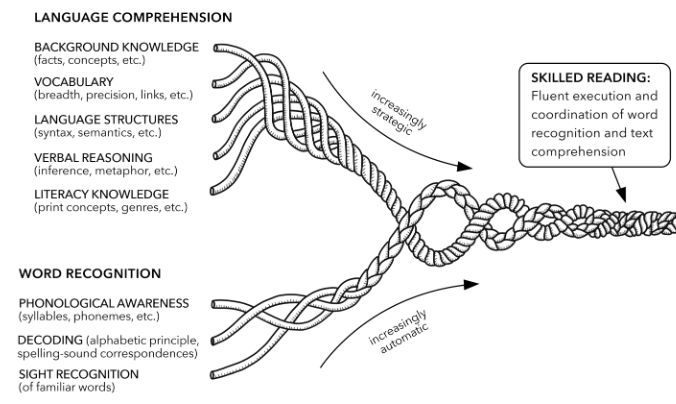
While these are important and relevant standards, they are listed as reading standards, not listening. The CCSS states: "The following standards offer a focus for instruction each year and help ensure that students gain adequate exposure to a range of texts and tasks. Rigor is also infused through the requirement that students read increasingly complex texts through the grades (emphasis added)." The disconnect for teachers comes when implementing a code-based approach to teaching reading. These teachers are focusing the majority of their direct instruction on phonemic awareness and phonics skills to follow research that demonstrates how important developing these skills to automaticity is. The language development areas of Scarborough's Reading Rope are often addressed through read-alouds that allow teachers to share more complex language and story structure. However, in many schools, teachers are asked to grade using standards-based report cards. They struggle because these goals are listed as reading skills, yet decodable books that students are reading often do not lend themselves to these standards. This creates a stumbling block as teachers diligently work to revamp their instructional practices and realign their curriculums. They struggle with how to implement best practices based on SoR research while being required to report out using these standards. They feel conflicted because while they address these standards, it is typically through other methods that students are able to engage with using speaking and listening skills.
    Similarly, another disconnect in our educational system involves the CCSS and our Special Education evaluation system. As mentioned, the CCSS raised the bar with expectations for grade levels down to kindergarten. Students who struggle to meet these higher standards can often be observed in schools across NH. They usually receive intervention support through the school's RTI system or Title 1. The tension comes when RTI systems expect students to "catch up" in 6-8 weeks of additional support. When they do not and go through several rounds of RTI, a decision to move to Special Education referral is often made by the student's educational team and/or parents. The disconnect comes when Special Education academic testing uses tests normed by age. In contrast, the student's struggles to get to this point were created by a CCSS-aligned tier 1 system that measures their progress based on grade level standards. This can result in students who struggle in the classroom yet do not qualify for Special Education. Often these students remain in a school's intervention system. These systems are moving towards more of an MTSS (Mulit-Tiered System of Supports) that casts a broader umbrella over student needs, including SEL factors, curriculum design, and collaboration with families in the problem-solving process. In this system, students can phase in and out of support as necessary when not meeting grade-level standards but also not qualify for Special Education. These are the students I have spent much of my career as a Literacy Specialist working with. Let's be clear: providing these MTSS supports is NOT a wait-to-fail model. A student does not need an IEP to receive the supports they need if a proper MTSS system is in place. But the struggle over when to refer and when a student will qualify for Special Education remains a gray area in most schools and an area that lacks clarity, causing anxiety among both educators and families.
    None of these disconnects will be fixed overnight. But they are the current reality that school employees face regularly. We can only start to better align our system once we realize the areas that create the triangle instead of a circular wheel. I would propose the following action steps to address some of these issues:
  1. If your school used a standards-based report card and is moving to an SoR based approach to teaching literacy, some time needs to be spent aligning SoR practices with the standards and discovering where there is room for clarification (for both educators and families).
  2. Professional development for regular education teachers about the types of assessments used for special education evaluations. Likewise, time in classrooms and with grade-level teams would help special educators understand the demands in tier 1 to meet CCSS. An understanding that special education cannot fix and tier 1 problem must be acknowledged. However, clearly articulating special education referral systems and rights protected by law is also needed (for both educators and families).
  3. A school-based team that starts to address some of these disconnects, makes decisions about resolving inconsistencies and communicates to staff to provide clarity and reduce anxiety.
These factors have implications for our students but also for the culture and climate of our buildings. Pretending they are not there doesn't help anyone involved. We need systems that create round wheels for our cars so that we can help guide students through their literacy growth with speed, efficiency, and effectiveness. 


Monday, March 27, 2023

The Systems that Drive Change

Systems exist in a variety of forms throughout education. We use different terms to refer to these systems: macro and micro, building and district level, MTSS and Special Education. The list could go on and on. However, like interconnected gears, it takes systems that carefully weave together to result in the best outcomes for our students. Making the switch to evidence-based practice grounded in Science of Reading research requires supporting teachers to change their practice and having strong leadership that carefully evaluates and adjusts curriculum, assessment, and school structures as needed. Creating change that is sustainable and has a high level of student impact requires participation at all levels - school boards, district leaders, building leaders, and practitioners.  When all of these stakeholders start rowing together, in the same direction, is when we see the needle start to move for our students. 

When working in our schools, the day-to-day realities of teaching and mentoring students can put blinders on our view.  The work is fulfilling but also taxing and exhausting, and there is often little energy left to think much beyond our own buildings.  One fantastic opportunity this sabbatical has provided me with is being able to step outside my bubble.  I have had the chance to see systems and initiatives at the state level, the district level, the building level, and the classroom level.  While no two districts or classrooms are the same, what has become abundantly clear to me just how much systems matter.

Attending literacy symposiums and conferences outside NH has also allowed me to peek at how other states are handling the challenges presented when dealing with the current literacy crisis.  For example, in many states, literacy coaches are almost more common than literacy specialists.  An emphasis has been placed on supporting educators with applying research-based principles to their teaching, and the research supports this.  Other states have moved forward because of new laws in their state or initiative pushed by their state's Department of Education. While some have been more successful than others, it is in the details of the systems that success is found.

When we take a slightly more micro view, we look to districts to see how systems function at this level. This is where the bulk of change happens in a local control state like NH.  Some districts are larger and must consider different age levels where students come together in larger school settings as they grow.  These districts have the challenging task of aligning all schools in their district, so that students receive similar instruction throughout the grades and have similar backgrounds as they merge together in middle or high school.

One theory I've come to appreciate I originally heard from Susan Hall of the 95 Percent Group. She discussed the need to create a "literacy ecosystem" for students.  This can be done by purchasing a curriculum, but it can also be achieved by aligning teaching standards and practices vertically throughout a school.  When we think about this alignment, it is essential to think vertically and horizontally as well as think about any support systems such as MTSS or Special Education that are present.  If we can use similar instructional routines throughout our tiers, students and teachers are able to save "cognitive desk space." This allows them to free up mental energy for the learning and teaching of skills and content rather than new routines.  If our instructional methods are evidence-based, they will work for the majority of our students.  What students will need is varying amounts of practice and repetition to master those skills and this is where MTSS supports come into play.

Another system that contributes to building a robust literacy ecosystem is the use of data.  I have seen this in many different forms throughout the state.  And while assessment data is being collected (and often in copious amounts!), it is how we use this data that makes the difference.  Having universal screeners that are quick and reliable is the first step.  These assessments, which should be given to all students,  must not use a significant amount of essential instructional time.  Instead, in their brevity, they serve as a sort of temperature check to determine if students are on track for grade-level expectations. Students who do not meet benchmark levels should then have follow-up diagnostic testing completed to pinpoint the area(s) of weakness and help inform instruction to fill in these gaps.  

But while these steps are taking place, it is also essential to have a system in place through which data follows the student.  In some systems, this is built in through data tracking software or Google Sheets created as "Kid Grids." But in other districts, there are bumps and gaps where students do not have their data follow them. This can result in students "slipping through the cracks" of the system.  If our goal is proficient reading for all of our students, we must track our students' progress and provide them with the necessary supports - even in middle and high school.

MTSS Assessment System (note: in well-functioning systems, assessment data informs instruction)

To summarize, what I am advocating for here may seem simple but is actually quite challenging to achieve.  I believe that it is when systems are working cohesively at all levels that we will make the most impact on our students. As you reflect on your own experience as an educator or parent (or like many of us, both), I would urge you to ask these questions:
  • Is there synergy between what is being presented at different levels of the system (state, district, building, and classroom level)? Are you getting consistent, research-based leadership when it comes to literacy instruction?
  • What systems are in place to guide best practices at the state, district, building, and classroom levels? Are educators being supported in the changes they are being asked to make?
  • Is there a literacy ecosystem in your building?  If so, what is it? Can you articulate the common beliefs that instruction operates under and the research upon which it is based?
  • Are members of all of the systems willing to have hard conversations?  These conversations involve deep dives into data, identifying trends, and constantly working toward improvement.  They involve all stakeholders setting goals for student progress and holding each other accountable for these goals by working collectively to support and better one another.
Perhaps the most important conversation at the root of all systems is a fundamental question about our belief in the ability of children to learn to read.  Do all members of the system understand and believe the research that states that with evidence-based practice, we can get 90-95% of our students to be proficient readers? This universal belief in the ability of our students, and the refusals to make excuses, is what we need to drive our systems to be effective.  The change will not happen overnight, but it is possible.  Let's all dedicate ourselves to being part of a system, no matter what role we may play, that fights for literacy for all students and drives change.


Wednesday, January 25, 2023

Moving Forward into 2023


Last month, EdWeek published an article reflecting on 2022 entitled A Year in Reading Instruction: 7 Developments You Need to Know. There were many familiar themes to those of us in literacy, including legislation to usher in practices based on the science of reading, the nationwide growth in LETRS training for elementary educators, and changes to curriculum products. As we move into 2023, hear are some of the topics I see taking the spotlight in the months ahead. 

Moving from Training to Implementation 
Teachers, not programs, teach students how to read. Most educators know this, and it is something that is repeatedly said in my LETRS training. The NH Department of Education providing LETRS training this year has been a tremendous opportunity. However, with the last cohort scheduled to start fall of 2023, two questions will need to be addressed moving forward. First, how will the state and/or districts support teachers with applying the knowledge gained from LETRS? When reviewing research on the impact of LETRS, it is clear that the impact on students is when literacy coaches support teachers in applying the knowledge to their teaching. Second, the state and districts must determine how to build sustainability and keep the momentum going. After the last cohort of LETRS training, will the state have an option available to teachers new to the state or who didn’t take the training already? The LETRS training was optional. How do the state and districts move ALL teachers forward using evidence-based structured literacy approaches while maintaining a local control model? 

Literacy Legislation 
2023 will likely continue to see states nationwide use their legislature to create change. In New Hampshire, there are currently two House Bills in committee looking to do the same thing. These bills are HB-377: relative to screening and intervention in public schools for dyslexia and related disorders: http://gencourt.state.nh.us/bill_status/billinfo.aspx?id=295&inflect=2 and HB 437: relative to a reading assessment and intervention program: http://gencourt.state.nh.us/bill_status/billinfo.aspx?id=720&inflect=2. Staying informed and engaged on this legislation will be important in the year ahead. 

A Necessity for Education and Leadership around Change 
Change can be difficult. But if there’s one thing in life that is a given, it is change. Supporting change within organizations takes careful leadership. Moving beyond literacy to understanding the basic tenets needed to make a positive organizational change will be an important topic for educators in leadership roles. Adam Grant’s book, Think Again: The Power of Knowing What You Don’t Know could be a good place to start. In the book, Grant says, "Strong leaders engage their critics and make themselves stronger. Weak leaders silence their critics and make themselves weaker." Leaders need to be open to having the hard conversation that change requires. They also need to create a culture that embraces another quote of Grant’s: "Changing your mind doesn’t make you a flip-flopper or a hypocrite. It means you were open to learning." 

Addressing the Literacy Needs of Middle and High School Students 
Although we know that early intervention is where we can make our biggest impact, kids inevitably slip through the cracks for various reasons (i.e., moving, etc.). In our current educational system, these kids often get support to make it through middle and high school content. Still, they do not necessarily receive the direct instruction they need to become proficient readers. Moving forward, middle and high schools will need to figure out structures to provide this instruction and ensure that all students graduating with the NH diploma are proficient readers. Julie Brown, the District Literacy Facilitator of the Windsor Central Supervisory Union in Woodstock, Vermont, has developed a model for adolescent structured literacy that both respects students and provides them with what they need. You can read more about their program here. 

Reading as a Human Right: Addressing Inequities in the System 
Organizations, from the United Nations to the International Literacy Association to the National Association of Elementary School Principals, have recognized literacy as a basic human right. Kareem Weaver, from Fulcrum Oakland, is quoted as saying, “Literacy, in the Information Age, is the essential gateway to society. Students must have consistent access to direct, explicit reading instruction that systematically develops foundational reading skills for the greatest number of learners. The Science of Reading must not be considered an ideological preference, pedagogical inclination, or inevitable swing of an instructional pendulum. Rather, the research consensus and supporting science must be applied as a matter of equity and civil rights.” Weaver is a leader in the movement for equity in literacy instruction and also said this at the 2021 Reading League Conference, “If your literacy program is not structured to get the most number of kids to the top, or to that level of society, or to proficiency, there is no equity. There can be no equity, no social justice, without literacy.” The pandemic exposed the inequities already present in our education system. When one looks at the statistic surrounding students who do not achieve proficiency in literacy in school, the numbers are daunting. All students must have access to high-quality instruction that works for the majority of students. Continuing to rely on systems that require tutoring at the family’s expense to find success for their children will continue to feed this inequity. We have seen parents begin to organize around this issue, and in Oakland, CA, they sued the state and won. You can read more about that case here. The Oakland case could easily set precedence for future legal cases surrounding the equity of literacy instruction. 

The Pitfalls of Labels 
Many of us experienced the arrival of CCSS and saw many programs that stamped their program with “CCSS aligned” and remarketed their product. There’s evidence of this starting to happen with the term “Science of Reading.” In a recent episode of Amplify’s Science of Reading: The Podcast, Donna Jetjmanek noted that she wouldn’t mind seeing the term “evidence” added to Science of Reading. She also noted the danger of people dismissing it by thinking of it as yet another educational pendulum swing. Moving forward, those in the field will need to work to ensure that the research and practices behind the Science of Reading are moved forward and not reduced to just a label. They will need to work to ensure proper use of the term and ensure that people do not oversimplify it by equating the Science of Reading with just phonics, for example. Educating others about the many facets of the Science of Reading will be critical. 

An Emphasis on Higher Education Programs 
I mentioned Donna Jetjmanek above, the creator of the Facebook page Science of Reading: What I Should Have Learned in College. This page started in the summer of 2019 and currently has over 200,000 followers. This speaks to the need that exists among educators to find the information they feel they did not receive in their university classes. Mount St Joseph University in Ohio may serve as a prototype of what future programs could look like. Their graduate and doctoral programs in Reading Science are in such high demand that there is a long waiting list. Additionally, only 19 University programs are accredited by the International Dyslexia Association (IDA). They can be found here. Students looking for college-level courses in the Science of Reading do not currently have many options. Not only is there a need for this type of education, but there is also an increasingly large market for it. 


2023 appears to be a year that will include more change, advocacy, and attention around the belief that all children have the right to become proficient readers. While the work will not happen overnight, educators continue to know better and do better. I look forward to continuing to develop my learning and staying open to change in my current understanding. There is no double that 2023 will be full of momentum to create the changes that give all students the right to become literate, participating members of society.

Tuesday, December 20, 2022

Let's Talk About ORF

"Given the fact that there's never enough time in classrooms for the instruction, which is the most important thing we do, instruction and intervention, I want to be very cautious about how much time is being spent on data collection."  ~Dr. Jan Hasbrouck 

When you visit your doctor, the initial part of the visit is usually a series of screeners: temperature, blood pressure, pulse, etc.  These measures are relatively quick and give an indication of any health issues you may be having.  Let's say, for example, that you register a fever.  Your doctor will not diagnose you with a fever and send you home.  Typically, they will look deeper through observation, discussion, and diagnostic testing to find the underlying cause of your temperature.  If we use this analogy to look at literacy assessment and instruction, taking your temperature is very similar to the role that Oral Reading Fluency (ORF) assessments play.

ORF assessments were developed in the mid 1980s, with Hasbrouck & Tindal completing research on their first ORF normed assessment in the late 1980s and publishing it in 1992.  Since then they have updated their norms in 2006 and again in 2017 (see below).  Dr. Jan Hasbrouck has admitted to being skeptical of the assessment when first learning about it from Gerald Tindal.  Her initial response was very similar to my own, namely, how can a one minute cold read possibly be enough to really tell us anything about a student's reading?  I personally struggled with this for years and it was through listening to and reading Dr. Hasbrouck's work that I finally fully wrapped my head around the beauty of this simple assessment.

Hasbrouck & Tindal's 2017 ORF Norms


First, I think it is essential to understand that ORF assessment scores are not in and of themselves important.  Rather, it is what they could indicate that is important.  To continue with the medical analogy, students who score below the 50th percentile on the Hasbrouck & Tindal ORF norms could be considered as having an "academic fever." Our job is to dig deeper and figure out what's causing that fever through diagnostic assessments and informal screeners.  We can again refer to Scarborough's Reading Rope when thinking about this.  Students who can read but are performing below the 50th percentile on ORF assessments often have strands of the reading rope that are loosely woven together. It is only when we help students tighten these strands that they will develop into skilled, proficient readers.

Scarborough's Reading Rope

So, what's next when we have a student scoring below the 50th percentile? This is when we use informal screeners and diagnostic assessments to look at the Word Recognition and Language Comprehension strands of the Rope.  Most frequently, it is holes in skills from the Word Recognition section of the Rope that are the root issue.  Weakness with sight word recognition, phonics skills, and phonemic awareness are common among these students.  Also, vocabulary skills can play a role because if a student knows the function and meaning of a word, it makes it easier for them to turn the word into a sight word (It is important to note here that the term sight word means any word that is recognized instantly, whether it is phonetically regular or irregular, and it is based on the process of orthographically mapping that word for immediate retrieval).  I have developed a document called ORF Assessment: Next Steps to help guide you through this process (see below).

ORF Assessment: Next Steps

The danger of ORF assessments is when they are misused.  Some mistakenly use it as a diagnostic assessment and treat students with low ORF scores through fluency interventions meant to build their reading rate.  This is flawed for two reasons: one, it fails to look deeper at underlying skill deficiencies and two, it demonstrates a fundamental misunderstanding of the term "fluency." It is important to remember that true fluency is more complex and includes not just rate but also expression, prosody, and it is connected to comprehension.  Hasbrouck herself has said that she wishes she could rename the assessment since it is truly automaticity that it is looking at, not fluency.  She now refers to it as Correct Words Per Minute (CWPM). 

Tim Shanahan has made the case for daily reading fluency practice as part of how to schedule your literacy instruction.  This can look different depending on where students are at in their literacy development.  For students just beginning school, this could be work at the sound and letter level.  Novice readers (typically late kindergarten to first grade) often complete fluency practice with decodable texts.  Both of these beginning levels need to complete this practice with a teacher or in peer groups in order to gain the practice they need and get immediate feedback.  As students move on to "break the code" and enter what Ehri refers to as the consolidated phase of reading, they are able to move into more varied text and can benefit from independent reading at this point.

Finally, I'd like to make the case for yearly ORF assessments being completed through high school with students.  The beauty of this assessment is its speed.  It is incredibly quick to administer which saves important instructional time at the elementary level.  But, as students move on into middle school and high school, it is too often taken for granted that they are proficient readers.  Students who receive services through an IEP are often supported in completing their classwork but do not receive the remediation they need to actually become proficient readers.  Results of the 2019 NAEP Assessment of 12th graders (it was not completed with 12th graders in 2022) show that 30 percent of 12th graders are reading at below basic levels.  While we often focus on elementary students because we know we can have the biggest impact through providing early intervention, we cannot simply discount these older students.  Completing yearly ORF assessments on students of all ages would assure that we would not let students slip through the cracks.  We owe it to our students to assure that earning a high school diploma means you have proficient reading skills.  There are many other requirements necessary to earn a high school diploma that meets NH's minimum state standards... why would proficient reading skills not be one of them?

National 2019 grade 12 NAEP Reading Scores (was not given in 2022)


Monday, November 7, 2022

Collaboration and Collective Teacher Efficacy

Take a second and think back on some recent events in your professional life.  First, I want you to think about a recent meeting you were part of that was tense.  It could be a PLC meeting, a referral meeting, a staff meeting.  As a teacher, there’s really no shortage of meetings.  Think how you felt leaving that meeting and going back to your students.  Now I want you to think of a similar meeting that went smoothly.  What characteristics did this meeting have that the first did not?  How did you feel leaving this meeting and returning to your students?

I’ve been thinking a lot recently about collaboration and the energy to teach.  We all know that our profession is struggling with an abundance of burnout right now.  If you don’t feel it yourself, I guarantee you can see it in the faces and voices of your colleagues.  Now, on top of the many issues that are zapping educator’s energy to teach, we are asking them to completely change their instruction and take significant amounts of time to learn about the Science of Reading and how to implement new practices.  While most teachers recognize that this work is essential, I think as a profession we need to be thoughtful on how we proceed.  We want teachers who are invested, motivated, and collaborative.  The way we roll out new “initiatives” has such a big impact on the ultimate impact they have.

Back in 2001, I was just starting my career in education.  At this time the impacts for NCLB federal law was just starting to be felt.  It was in this atmosphere that Donald Graves wrote the book, The Energy to Teach.  In this book he refers to a case study in Maine.  He details a procedure where the state invited districts who were doing well and having student success to share their story at a retreat.  Brenda Power, a professor of education at the University of Maine, was part of the retreat and noted, “ Teachers in these schools are really a part of a community, and were respected as professionals.  While they had latitude and flexibility, they were working from some sort of shared vision or mission.” When you leave a meeting or professional development day, do you feel energized by a shared vision or mission?


This brought me to the idea of Collective Teacher Efficacy.  John Hattie, a well known and respected researcher in education, is perhaps best known for his meta-analysis of instructional strategies to determine their effect size on learning.  His most recent research tells us that Collective Teacher Efficacy has the highest effect size in student learning with an positive impact size of 1.57.  Teacher Efficacy is the belief of one’s own ability to promote positive change for students.  However, Collective Teacher Efficacy is the belief of a teacher group about their collective ability to promote successful student outcomes within their school.  This means the single biggest indicator for the success of Science of Reading based practices is to create an environment conducive to Collective Teacher Efficacy in schools.  Hattie’s research tells us that when educators are given the time and structure to come together regularly, share best practice, dive into relevant data, and put a plan together, this has a major impact on student success.


So, how do we make this happen?  How do we best support our teachers as they take on the task of learning SoR research and putting it into practice in their classrooms?  The first thing that is needed is at the leadership level.  School and District Leadership needs to learn the SoR research alongside their teachers and create time and supports within their school calendar and schedule to support this learning.  PLCs can be a wonderful avenue for this.  However, teachers need support and training in how to best use this time together.  This is where the idea of literacy coaching comes into play.  Having a literacy coach to work collaboratively with teachers has been shown to increase teacher knowledge and have a direct impact on Teacher Efficacy.  When this coaching happens within the model of PLCs, it can have an even larger impact through helping to create a sense of Collective Teacher Efficacy.  Not only do coaches help teachers feel supported in their instruction, through the collection and organization of data they can help teachers see the student successes that result from their change in practice.  This is what creates Collective Teacher Efficacy by showing teachers the evidence of the impact of their change.  Knowledge of SoR is essential, but Literacy Coaches can help it have the intended impact by supporting teachers through the shift in how to change their practice, priorities, and structures.


But we all know that not every school will have the backing for a Coaching program.  What to do then?  Well, the group Cult of Pedagogy coined the phrase “find your marigold” when speaking about new teachers about a decade ago.  A marigold is a flower that can be planted to protect other plants within its boundaries from weeds and insects.  In the field of education, “finding your marigold” refers to surrounding yourself with other educators who feed your energy to teach instead of zapping it.  This concept can be applied as you move forward in the shift to SoR based practice: find your marigold.  Who are the people in your building who are ready to go on this journey with you?  Keep them close and support one another.  Finding our marigolds helps build Collective Teacher Efficacy and we know that ultimately positively impacts student achievement.  


An alternative to finding your marigolds in your school building is finding them online.  There are numerous online communities that support and inspire work based in SoR research.  Probably most well known is the Facebook group “Science of Reading - What I Should Have Learned in College,” but there are many others out there, too.  Professional organizations, such as the IDA-NNEA, can be another powerful source for finding your marigolds and nurturing your energy to teach and make important shifts in your practice.


I am lucky to work in a building that is full of many blooming marigolds.  Working with them when we are given the time and space to do so, energizes my teaching and encourages me to move forward with new ideas. Being on sabbatical, I have missed the energy I get from that staff every day.  However, during my sabbatical, I have had the opportunity to speak with numerous people who are working to further the knowledge of SoR research and practice.  I find myself leaving each and every one of these meetings with a renewed sense of purpose and excitement about the important literacy work that lies ahead.  I get a sense that there’s a beautiful garden of marigolds blooming throughout the country.  I couldn’t be more proud to be one of those marigolds and I invite you to join our Literacy Leader NH group to find your marigolds in the state of NH. We have important work to do, and supporting one another while focusing on student achievement is essential for the future of our profession and the success of SoR based practices in our schools.


Wednesday, September 28, 2022

Literacy Leaders NH has a new website!


Most people who know me personally, know that I love music.  I love all kinds of music, but I particularly love musical theater.  There’s something about the ability to tell a story with music that is just spellbinding to me.  Two of my favorite song writers are Lin-Manuel Miranda and Steven Sondheim.  This past month I have been reminded of an interview I saw with both of them around the time that Miranda’s groundbreaking musical, Hamilton, was just making its debut on the Broadway stage.  Lin expressed a time in the creation of Hamilton when he felt that he was just drowning in research.  It almost made it impossible for him to sort through and move forward.  Sondheim and one of his collaborators, John Weidman, who wrote Assassins with him,  gave Miranda some wise advice.  At some point, they said, you had to just “just write the parts you think are a musical.” Simply put, sometimes you just need to move forward to get the work done.

This past month, as I’ve embarked on my sabbatical project, this advice has come to mind several times.  Like many of you, I often bookmark, save, and file new research about how our youngest students learn to read and write.  Maybe it’s the headline that grabs my eye.  Or maybe it’s the names involved in a research study that pique my interest.  But in the busy day to day life of an educator, there’s usually little time to read all of this information and so it starts to simply pile up on a wish list of professional development.  One of the great gifts of a sabbatical is the opportunity to go through all of these saved resources, which is exactly what I’ve been doing this month.

As I slowly made my way through the research studies, literacy symposiums, blogs, and articles I asked myself questions.  First, I thought about how relevant and reliable the information provided would be to educators on the front lines.  It was important to me to make information that’s relevant to everyday teaching available to teachers in an easily accessible way.  Second, I considered the sources.  Many programs, companies, and websites have jumped on the bandwagon and stamped “research based” or “evidence based” on their literacy curricula, but it’s important to carefully evaluate such claims.  Episode 125 of the podcast Melissa & Lori Love Literacy helped me with this process as they interviewed Andrew Watson, an educator and author, who spoke about how to best discern and distill this information.  He suggested using these three questions to help unpack the legitimacy of research and information:

  • Determine if you trust the speaker or person presenting the information.  Ask yourself what is the best research you know of that supports that idea?

  • Review the study or material.  Ask yourself if it is a good proxy for your students or scenario?

  • Look for more research and consider which way does most of the research point you in?

And finally, I feel that it’s very important for information to be provided in a helpful and nonjudgmental way.  Reigniting the Reading Wars will not help teachers or students.  I look at this work for both myself and other educators as a collaborative process where we should be supporting and challenging each other, not vilifying each other.  Often the first way to achieve that is to provide the “why”, the research behind why we need to make instructional changes, to move forward together. This is why I consistently ground my own work in the quote “when you know better, you do better.”


All this leads me to share with you the website I have created to try to consolidate and centralize all of this information.  Literacy Leaders NH now has an official website where you can go to find Science of Reading research (the why) and information on best practices (the how).  This site is for all NH educators and my hope is that it will continue to grow and develop over the course of the year.  For now, it is a compilation of all that information I’ve been drowning in for the last year.  Much like Lin-Manuel Miranda had to “just write the parts he thought were a musical,” I wanted to just get the information I thought was most important for educators out to you as quickly as I could.  I hope you find it a valuable resource for your own teaching and for the educational systems you work within.  I look forward to hearing from you about what pieces work for you and what you’d like to see more of.  Together, as collaborative educators, we can better our own practices while supporting each other to help more of NH’s students achieve the literacy levels they deserve for a productive and successful life.

(Don't forget to subscribe below to get emails about new blog posts and other updates!)

Thursday, September 1, 2022

The Road to Change

Do you have early memories of reading?  Are they positive or negative?  Do you remember learning to read in school?  What do you perceive your experience to be as an adult reader?

The answer to these questions can have a large impact on your thoughts and feelings about how to best teach reading.  Despite not being based in any scientific research or longitudinal studies, they are your own personal experience and can lead to confirmation bias as you encounter new information.  I know that this was certainly true of my own experience.  

Reading came rather naturally to me.  I was lucky to be raised in a house surrounded by books, with a family who encouraged reading and read to me regularly.  Some of my fondest childhood memories are of weekly visits to the library.  And after I took to reading rather quickly in the elementary grades, I developed a love for books and found a favorite series in the Ramona Quimby books by Beverly Cleary.

As I grew, I knew that my love for books and writing were going to be part of my life and career.  I started my undergraduate degree as an English major thinking that perhaps I would teach high school English.  I love The Catcher in the Rye and A Tree Grows in Brooklyn and could see myself sharing these novels with teenagers in the classroom.  But by the time I was nearing the end of my sophomore year, my interest had shifted to how kids learned to read and what language development in general entailed.

This was the late 1990s and it was only during my graduate work in 2000-2001 that the National Reading Panel report was published.  As a result, a lot of my coursework focused on surrounding children with high quality literature and helping them to develop a love of reading.  Given my own experience with learning to read as a child, this made perfect sense to me and connected with my own experience learning to read.  I went into teaching wanting to give all my students the wonderful and magical experience with books that I had.

It was not until around 2016 that I really started to wonder about some of my long held beliefs about teaching reading.  At the time I had been working as a Literacy Interventionist for about six years and was deeply rooted in the balanced reading method of teaching.  But it was also around this time that my school implemented Fundations and my own son started to show some struggles with learning to read in his early elementary years.  A combination of professional development around Fundations and experience as a parent led me down the road of wanting to learn more about what happens in the brain when we learn to read and how we can better help struggling students.

One of the first things I learned to both make me start to question my own practice and become more interested in diving deeper into the research, was that spoken language comes naturally.  Our brains are hardwired to pick up the languages that are spoken around us.  However, learning to read is not a natural process for the brain and must be taught.  From this comes the idea of a phoneme to grapheme approach to teaching best explained by Dr. Loisa Moats in her book, Speech to Print: Language Essentials for Teachers. 
The amount of direct instruction required to learn can vary from student to student, but it is not something that happens naturally.  Now, it is true that some students will learn to read easily no matter what method is used for instruction. However, many will not.  Dr. Reid Lyon found in his research that:

  • 5% of students learn to read effortlessly (these are often the students who come to us already reading when they start kindergarten)

  • 20%-30% learn to read easily with most methods 

  • 30%-50% find learning to read difficult and need systematic explicit instruction

  • 5%-20% find reading one of the most difficult tasks that they will have to master throughout their schooling (often students with dyslexia)

Take just a minute to soak this in.  Where would you have landed as a student?  My guess is that I would have been in one of those first two categories.  But look at the potential number of students that fall into the second two categories.  I wholeheartedly believe that learning to reading is civil right (for more on this, check out the Right to Read project), and knew that I needed to start doing the hard work of reflecting on my own teaching and educating myself about how I could better meet both the needs of my intervention students and the needs of all students in our tier 1 setting. 


Sometimes this reflection was difficult.  It could lead to feelings of guilt for past students that I realized I could have taught more effectively.  Or sometimes I encountered new research that was difficult for me to accept as it seemed unfamiliar to my personal recollections of learning to read.  But  time and time again I came back to the words of the late and wise Dr. Maya Angelou who famously said, "Do the best you can until you know better.  Then when you know better, do better."  This quote now guides my professional practice and has led me down many varied paths in the past six years to grow my own professional knowledge and share that knowledge with others.  This journey is what ultimately led me to apply for the 2022-23 Christa McAuliffe sabbatical with a project based around the Science of Reading (SOR) and how to support NH teachers with learning about the SOR and putting this research into practice.


So, I invite you to subscribe to my blog (leave your email in the subscribe box below) and follow me on the journey this year.  I hope to write about the research, its implications for our instructions, my time in NH schools, and also my experiences and wonders as the year unfolds.  Ultimately, I hope this and my social media feeds can be a place for NH teachers to connect, learn, and support one another.  We have all been "doing the best we can until we know better" and now it's time for us to "know better and do better."